The question I hear most after a car break-in goes something like this: “My laptop got stolen out of my car in a Dallas parking lot. My window was smashed and my computer is gone. Does my insurance cover any of that?” I’m Dhyana Newton with DRH Insurance Group here in the Dallas-Fort Worth area, and the answer catches a lot of people off guard. So let me walk you through a real-world style story that shows how the pieces actually fit together.
My goal is to explain how this works, not to sell you anything. By the end, you’ll understand how homeowners insurance stolen items from car Dallas coverage generally works, what limits to watch for, and the steps you’d take if it ever happened to you. Let’s get into it.
A quick story: the Uptown parking lot break-in
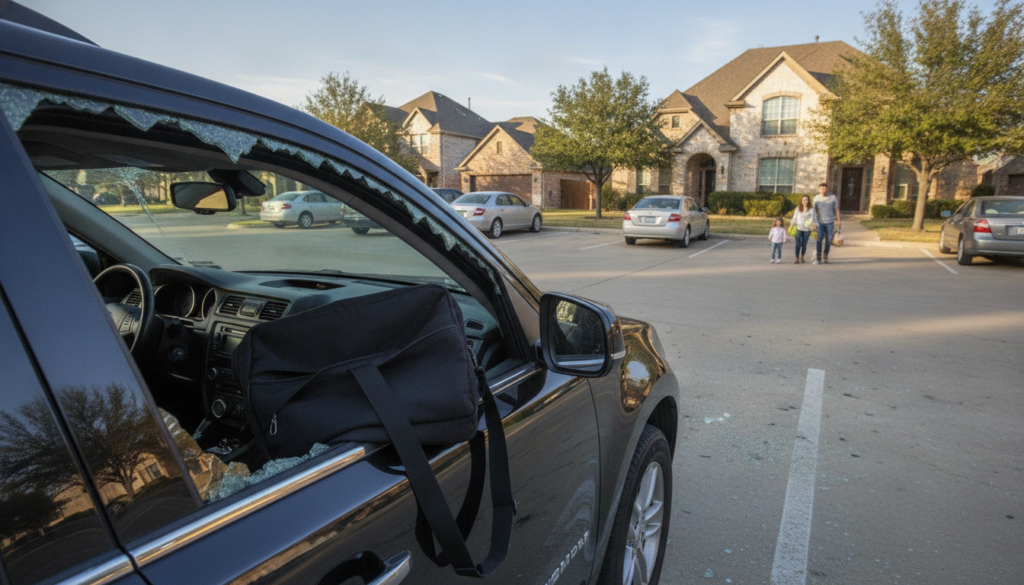
Say a DFW resident named Marcus lives in an apartment near Uptown Dallas and drives into the office a few days a week. One Tuesday evening he parks in a lot near his building, grabs dinner with a friend, and comes back two hours later to find his passenger-side window shattered. His backpack is gone. Inside it: his personal laptop, a nice pair of headphones, a tablet, and a leather bag his sister gave him.
Marcus’s first instinct is to call his auto insurance. That’s a reasonable place to start. But here’s where people get tripped up. His auto policy may help repair the broken window, depending on his coverage, but auto insurance usually does not pay for the personal belongings that were inside the car. That’s the part that surprises folks.
So who covers the stolen laptop, tablet, headphones, and bag? In many cases, that’s where his homeowners or renters policy comes in. This is the whole point behind homeowners insurance stolen items from car Dallas coverage: the vehicle and what’s inside it are handled by two different policies.
Rule of thumb: your auto policy tends to cover the car itself. Your home or renters policy tends to cover the stuff inside the car. Two policies, two jobs.
Why homeowners insurance stolen items from car Dallas claims confuse people
The confusion makes sense. The theft happened in your car, so your brain jumps straight to car insurance. But insurance is organized around what got damaged or stolen, not just where it happened.
Here’s a cleaner way to think about it:
- Auto insurance generally addresses physical damage to your vehicle. In Marcus’s case, the broken window would fall under his auto coverage, if he carries the type that applies to that kind of loss. A deductible usually applies there too.
- Homeowners or renters insurance generally addresses your personal belongings, including many items that happened to be in the car when they were stolen.
So a single break-in can involve two separate claims on two separate policies. That’s a big reason homeowners insurance stolen items from car Dallas questions get complicated fast. Once you understand which policy does what, the whole thing gets a lot less stressful.
This is where working with a local agent helps. When I sit down with DFW families and small business owners, one of the first things we sort out is which coverage handles which situation, so there are no surprises on a bad day.
Meet Coverage C: the part of your policy that protects your stuff
The section of a homeowners or renters policy that helps with stolen belongings is usually called personal property coverage. You’ll often see it labeled as Coverage C on your policy documents.
Personal property coverage is built to help protect the things you own: furniture, clothing, electronics, sporting gear, and yes, laptops and headphones. Once you understand Coverage C, homeowners insurance stolen items from car Dallas scenarios start to make more sense, because that’s the bucket a stolen-laptop claim usually falls into.
What Coverage C typically includes
Standard personal property coverage generally applies to a wide range of belongings you own or use. That’s the everyday stuff most of us have. What matters for our story is that this protection isn’t necessarily limited to items sitting inside your home. Which brings us to a feature a lot of people have never heard of.
Off-premises coverage: the feature behind homeowners insurance stolen items from car Dallas protection
Here’s the piece that makes the whole thing work: off-premises coverage.
Most standard homeowners and renters policies include off-premises coverage, which extends your personal property protection to belongings even when they aren’t at your home. That can include items in your car, in a hotel room while you travel, or with you at a coffee shop. This is exactly why a laptop stolen from a car in a Dallas parking garage may be covered under a home policy at all.
Think about how often your belongings leave the house. Your laptop goes to the office. Your camera goes on vacation. Your kid’s tablet rides along on road trips. Off-premises coverage is the reason your personal property protection travels with those items. It’s one of the most overlooked features in a policy, and it sits at the center of how homeowners insurance stolen items from car Dallas claims are handled.
In Marcus’s story, off-premises coverage is what potentially opens the door for his stolen laptop, tablet, and headphones to be considered under his home or renters policy, even though the theft happened blocks from where he lives.
The catch: off-premises limits are usually lower
Now for the important part. Off-premises coverage typically comes with a lower limit than the coverage for items kept at home. A common structure caps off-premises protection at around 10% of your total personal property coverage.
Here’s a simple example so you can see the math:
- Say your policy includes $100,000 in personal property coverage.
- Your off-premises limit might be capped at roughly $10,000, or 10% of that total.
For most single break-ins, that off-premises limit is more than enough to cover a stolen laptop and a few other items. But it’s a detail you’d want to confirm on your specific policy, because every policy is set up a little differently. When I review a policy with a client, checking that off-premises number is a standard part of the conversation about homeowners insurance stolen items from car Dallas coverage.
Deductibles: what you pay before coverage kicks in
Any honest explanation of homeowners insurance stolen items from car Dallas coverage has to include the deductible, because it directly affects what a claim actually returns to you.
A deductible is the amount you agree to pay out of pocket before your insurer contributes to a covered claim. Personal property claims are subject to your policy’s deductible, just like other losses.
Here’s why that matters in Marcus’s story. Imagine the total value of his stolen items comes to a modest amount. If that total is at or below his deductible, filing a claim might not result in a payout at all, because the loss doesn’t exceed what he’d pay out of pocket anyway. On the other hand, if the laptop, tablet, headphones, and bag add up to well above his deductible, a claim starts to make a lot more sense.
This is a moment where a quick call to your agent pays off. Before you file, it’s smart to weigh the value of what was stolen against your deductible so you can make an informed decision. There’s no single right answer here. It depends on the numbers and your situation, and that’s a conversation I’m always happy to walk through with DFW clients.
High-value items and special limits: where homeowners insurance stolen items from car Dallas claims get tricky
Now let’s talk about the belongings that need extra attention, because this is where people are most likely to be caught off guard.
Standard policies often place special limits of liability on certain categories of high-value items. In plain English, the maximum payout for those categories may be lower than what the items are actually worth. Categories that commonly carry special limits include:
- Jewelry
- Watches
- Fine art
- Certain expensive electronics
- Collectibles
Back to Marcus. His laptop, tablet, and headphones may fall within his standard coverage. But imagine his backpack had also held an expensive watch or a piece of jewelry. Depending on his policy, the payout for that watch could be capped by a special limit, meaning he might not recover its full value under a standard policy.
Scheduled personal property: an option worth understanding
For high-value belongings, one option many people discuss with their agent is scheduled personal property coverage, sometimes handled through an endorsement, also called a rider. Scheduling an item generally means it’s specifically listed on your policy, often with its own agreed value, so it’s treated differently than the general special limit.
To be clear, I’m not telling you to schedule anything. Whether that makes sense depends entirely on what you own and how you value it. It’s simply an option to be aware of. If you own valuables that matter to you, it’s worth asking your agent, “How would this specific item be treated under my current policy?” That one question can head off an unpleasant surprise later. For anyone worried about homeowners insurance stolen items from car Dallas scenarios involving expensive gear, understanding special limits is essential.
Replacement cost vs. actual cash value: two very different payouts
Another detail that shapes homeowners insurance stolen items from car Dallas claims is how your policy values the stolen items. Policies generally settle personal property claims one of two ways, and it’s worth knowing which one applies to you.
- Actual cash value generally factors in depreciation. A four-year-old laptop is worth less than a brand-new one, so a payout on this basis may reflect that reduced value.
- Replacement cost generally aims to help you replace the item with a new equivalent, without subtracting for age and wear, subject to your policy terms and limits.
In Marcus’s case, if his laptop was several years old, the difference between these two approaches could be meaningful. Neither one is universally better. They’re just different, and they change what a claim looks like in the end. This is exactly the kind of thing I like to explain up front so my clients know what to expect before anything goes wrong.
What Marcus actually does: step by step after the break-in
Let’s finish Marcus’s story with the practical part. Say he decides the value of his stolen items clearly beats his deductible, and he wants to explore a claim. Here’s a sensible sequence, and it works as a template for anyone dealing with a car break-in in DFW.
1. File a police report
This is the first step. To pursue a theft claim, you’ll generally need a police report documenting the break-in and the stolen items. In DFW, that means contacting the local police department where the theft happened. Get a copy of the report or the report number, because your insurer will typically ask for it.
2. Document what was stolen
Make a clear, detailed list of every item taken. For Marcus, that’s the laptop, tablet, headphones, and bag, with brands, models, and approximate age where he can recall it.
3. Gather proof of ownership
This is where a lot of claims either move smoothly or bog down. Proof of ownership helps show what you actually had. Useful documentation can include:
- Original receipts
- Photos of the items, extra points if the photo shows the item in use
- Credit card or bank statements showing the purchase
- Email order confirmations
- Serial numbers, when available
Here’s a tip I give every client: don’t wait for a theft to start documenting. A few minutes photographing your valuables and saving key receipts today can make a future homeowners insurance stolen items from car Dallas claim far easier. A simple photo inventory on your phone goes a long way.
4. Contact your agent or insurer
Reach out to start the claim and ask questions. This is where a local agent earns their keep. I can help clients understand what to expect, explain how their specific policy is set up, and make the process feel less overwhelming during a frustrating week.
5. Understand how the two claims fit together
Remember, Marcus may have two separate situations: the broken window, potentially an auto claim, and the stolen belongings, potentially a home or renters claim. Each has its own deductible and its own process. Knowing this ahead of time keeps the whole thing from feeling like a maze.
Renters and condo owners: this applies to you too
I want to make sure nobody feels left out here. A lot of the DFW residents I talk with rent apartments in areas like Uptown, Deep Ellum, Fort Worth’s near south side, or the suburbs, and they assume this kind of protection is only for homeowners. Not so.
Renters and condo policies generally include personal property coverage and off-premises coverage in a similar way. So if you rent your place and your laptop is stolen from your car, the same general principles behind homeowners insurance stolen items from car Dallas coverage tend to apply to your renters policy. If you’ve been putting off a renters policy because you figure your belongings aren’t worth much, add up what it would actually cost to replace everything you own. Most people are surprised by the total.
What this means for DFW small business owners
Here’s an important wrinkle that matters for a lot of DFW entrepreneurs. In our story, Marcus’s laptop was his personal computer. But what if it had been a business laptop, or gear he uses to run his company?
Business property is often treated differently than personal property. A personal homeowners or renters policy may have limited or no coverage for property used mainly for business, and there are frequently sub-limits involved. If you run a small business, say a photography studio, a consulting practice, a food truck, or a contracting outfit, the equipment you rely on may need to be handled through business insurance rather than a personal policy.
I bring this up because I don’t want a DFW small business owner assuming their expensive work laptop or camera gear is fully protected under a personal policy when it might not be. This is exactly the kind of gap worth reviewing with an agent. When homeowners insurance stolen items from car Dallas questions involve business equipment, the conversation often widens into small business coverage options, and it’s far better to have that talk before a loss than after.
A few honest realities worth knowing
I always try to give people the full picture, not just the good parts. So here are a few honest realities about homeowners insurance stolen items from car Dallas claims:
- Coverage isn’t automatic or guaranteed. Every policy is different, and outcomes depend on your specific policy terms, the circumstances, and your documentation. I can’t promise any particular result, and you should be wary of anyone who does.
- Limits matter. Between off-premises sub-limits, special limits on certain categories, and your deductible, the amount recovered on a claim can differ from the sticker price of what was stolen.
- Deductibles can make small claims not worth filing. If the value of what was stolen is close to your deductible, filing may not make sense. That’s a personal decision worth thinking through.
- Documentation is your friend. The better your records, the smoother the process tends to go.
None of this is meant to discourage you. It’s meant to help you make good decisions with clear eyes. When you understand how the pieces work, you’re in a much stronger spot, both before and after something goes wrong.
How to protect yourself before a break-in ever happens
Prevention is always cheaper and less stressful than a claim. Here are a few practical, no-cost habits that go a long way in the DFW area, where opportunistic car break-ins do happen in busy parking lots and garages:
- Don’t leave valuables visible. A laptop bag on the seat is an invitation. Tuck items in the trunk before you arrive at your destination, not after, since thieves may be watching.
- Take the important stuff with you. The safest laptop is the one that’s not in the car at all.
- Build a home inventory now. Walk through your home and car gear, snap photos, and save receipts in a folder or a cloud drive. Future you will be grateful.
- Know your policy limits. Understand your personal property coverage, your off-premises limit, your deductible, and whether any of your valuables fall under special limits.
- Review after big purchases. Bought a new laptop, camera, or piece of jewelry? That’s a natural moment to check in with your agent.
Let’s talk through your coverage
Marcus’s story has a reasonably happy ending in a lot of cases. Because he understood that his belongings and his vehicle were covered by two different policies, he knew where to turn, documented everything, and made an informed decision about filing. That kind of clarity is what I want for every DFW family, driver, homeowner, renter, and small business owner I work with.
Every policy is different, and the right approach depends on what you own, how you use it, and what matters most to you. There’s no one-size-fits-all answer, and there’s certainly no pressure from me. If you’d like to understand how your own policy handles homeowners insurance stolen items from car Dallas situations, or you just want a plain-English review of your coverage, I’m always glad to help. I’m Dhyana Newton with DRH Insurance Group, right here in the Dallas-Fort Worth area, and I’d be happy to talk through your options whenever you’re ready.
Frequently asked questions
Does my homeowners insurance cover a laptop stolen from my car in Dallas?
In many cases, yes. Your personal property coverage may help with belongings stolen from your car, thanks to a feature called off-premises coverage. Your auto policy typically handles damage to the car itself, like a broken window, while your home or renters policy generally handles the stolen items inside. Coverage depends on your specific policy, so it’s worth confirming the details with your agent.
How much of my stuff is covered when it’s stolen away from home?
Off-premises coverage usually comes with a lower limit than the coverage for items kept at home, often capped around 10% of your total personal property coverage. So if you had $100,000 in personal property coverage, your off-premises limit might be about $10,000. Check your policy to confirm your exact off-premises limit.
Do I have to pay a deductible on a stolen items claim?
Yes. Personal property claims are generally subject to your policy’s deductible, meaning you pay that amount out of pocket before your insurer contributes. If the value of the stolen items is close to or below your deductible, filing a claim may not result in a payout. It’s smart to weigh the item value against your deductible before deciding to file.
What do I need to file a claim for items stolen from my car?
Start by filing a police report with the local department where the theft happened, then gather proof of ownership for the stolen items. Helpful documentation includes receipts, photos, credit card statements, and serial numbers. Contact your agent or insurer to begin the claim and ask questions along the way.
Are expensive items like jewelry or watches fully covered if stolen from my car?
Not always. Standard policies often place special limits of liability on high-value categories like jewelry, watches, and fine art, so the payout may be lower than the item’s actual value. If you own valuables you want fully protected, ask your agent about scheduled personal property coverage as an option to discuss.
Does renters insurance cover items stolen from my car in DFW?
Generally, yes. Renters and condo policies typically include personal property coverage and off-premises coverage similar to homeowners policies, so items stolen from your car may be covered under the same principles. Limits, deductibles, and special category limits still apply, so review the specifics with your agent.
Sources
- Does Home Insurance Cover Car Break-Ins? – Policygenius
- Does Home Insurance Cover Theft From Your Car | Allstate
- Does Homeowners Insurance Cover Theft From Your Car | belairdirect
- What Is Personal Property Insurance for Homeowners?
- Does Homeowners Insurance Cover Theft? – SoFi
- What Is Homeowners Insurance Off-Premises Coverage? – SmartFinancial