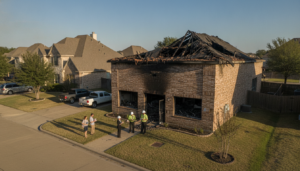

“If someone breaks into my shop overnight, what actually happens next?” We hear some version of that question all the time at DRH Insurance. It is a fair one. Most business owners never think about the answer until they are standing in a doorway with a busted lock and empty shelves. So we want to walk you through the whole process, start to finish, using a story.
A note about honesty before we start. The retailer below is a composite, a blend of the kinds of small businesses we work with across the Dallas-Fort Worth area. She is not one specific client, and we are not using any real names or real claim details. But every step, every coverage question, and every decision point matches what actually happens when a DFW business files a theft claim. The point is to make this feel real without pretending it is a single true story.
Meet “Bloom & Board,” Our Composite DFW Retailer
Picture a small home-goods and gift shop we will call Bloom & Board, tucked into a strip retail center off a busy road in the mid-cities area between Dallas and Fort Worth. The owner, we will call her Renee, runs it with two part-time employees. She sells candles, ceramics, small furniture pieces, seasonal decor, and a rotating shelf of local artisan goods. In a normal week she carries a fair amount of inventory, plus a point-of-sale system, two laptops, a security camera setup, and display fixtures she paid to have custom-built.
Like a lot of small retailers, Renee bundled her coverage into a Business Owner’s Policy, usually shortened to a BOP. A BOP packages three protections together: general liability, commercial property, and business interruption coverage. Small businesses lean toward it because it combines those pieces into one package, and buying them bundled is often more cost-effective than buying each policy on its own. The theft protection that matters in this story sits inside the commercial property portion of that BOP.
When Renee first set up her coverage with our team, we talked through the value of her inventory, her equipment, and her fixtures. We also talked about the difference between replacement cost and actual cash value, which turns out to matter a great deal once a claim happens. Hold that thought. It comes back later.
The Monday morning nobody wants
Renee got to the shop a little before 9 a.m. on a Monday to open up. The back door frame was splintered. The deadbolt had been forced. A section of shelving near the register had been cleared out. Both laptops were gone. The register drawer had been pried open. A chunk of her higher-value inventory, some artisan ceramics and a couple of small furniture pieces, had walked out the door overnight. Her security camera caught grainy footage of two people, but the plate on their vehicle was not readable.
Her first instinct was to start cleaning up and sweeping glass. That is completely understandable. It is also the exact moment where a lot of theft claims get complicated. What you do in the first few hours shapes how smoothly the rest goes.
What small business theft insurance DFW coverage actually includes
Let us pause the story and talk about what a policy like Renee’s is generally built to respond to. Small business theft insurance DFW protection usually sits inside commercial property coverage or a BOP, and in a burglary like this one, several different pieces can come into play at once.
- Stolen business property. This is the part most people picture first. Inventory, equipment, furniture, fixtures, computers, and supplies stolen from the business location are generally the core of what theft coverage addresses. For Renee, that means the missing ceramics, the furniture pieces, and both laptops potentially fall into this bucket.
- Damage from the break-in itself. Burglars rarely enter politely. The forced back door, the splintered frame, the pried register drawer, and any broken glass are physical damage to the premises. Commercial property coverage can respond to the cost of repairing that damage, not only the value of what was taken.
- Business interruption. This is the piece owners often forget exists. If a covered theft event forces the business to close temporarily, business interruption coverage inside a BOP may help with lost income and ongoing expenses during that closure. If Renee has to shut down for a couple of days to repair the door, secure the building, and re-inventory, this is the coverage that can matter most to her cash flow.
That combination is exactly why so many small retailers reach for a bundled BOP. A single burglary can hit property, the building, and income all at once, and small business theft insurance DFW coverage inside a BOP is built to address more than one of those angles from the same event.
Replacement cost versus actual cash value: the detail that changes everything
Remember that conversation Renee had with our team when she set up her coverage? Here is where it pays off. When you insure business property, you generally pick between two ways of valuing a loss.
Actual cash value factors in depreciation. A three-year-old laptop is not valued as a brand-new laptop. It is valued as a used one that has lost value over time. Replacement cost is designed to cover the price of buying a new equivalent item. For a business that depends on its equipment and inventory, replacement cost coverage is generally the option owners want to understand, because depreciation on electronics and fixtures adds up fast.
We are not going to tell you which one to buy. The right answer depends on your business, your budget, and your priorities. That is a conversation to have with an agent. But we will say this plainly. Knowing which valuation method your policy uses before a loss happens is far better than finding out during a claim.
Step by step: how the Bloom & Board theft claim unfolded
Back to Renee, standing in her doorway. Here is how a well-handled theft claim generally moves, using her situation as the example. If you remember nothing else from this article, remember these steps. They apply to nearly any small business theft insurance DFW claim.
Step 1: Secure the premises and stay safe
Safety comes first, always. If there is any chance someone is still inside, you do not go in. Renee stayed outside and called for help. Once it was clear the building was empty, the next job was preventing further loss. That splintered back door was now an open invitation to more theft or weather damage.
Here is an important nuance. You are generally allowed to make temporary, emergency repairs to protect the property from additional damage, like boarding up a broken door or covering a shattered window. What you want to avoid is jumping straight to permanent repairs before the insurance adjuster has had a chance to inspect. Renee had a handyman board up the door frame, took photos of it first, and left the permanent repair for later.
Step 2: Call law enforcement and get a report number
Renee called the police right away. This step is not optional if you want a smooth claim. Insurers almost always require an official police report for a theft loss, and you will want the report number for your records. The responding officers documented the forced entry, noted the missing items she could identify on the spot, and gave her a case number.
That police report does double duty. It creates the official record of the crime, and it establishes evidence of forced entry, which matters more than people realize. We will come back to why forced entry is such a big deal in the exclusions section.
Step 3: Document the loss thoroughly
Before touching anything beyond emergency cleanup, Renee documented everything. She took wide photos and close-ups of the broken door, the pried register, the empty shelves, and the general scene. Then she started building an inventory of what was missing.
This is where good record-keeping before a loss becomes a quiet hero. Renee had purchase receipts for her laptops, invoices from the artisans who supplied her ceramics, and photos of her showroom from a recent social media post that happened to show the furniture pieces on display. All of that became proof of ownership and value. The more documentation you can produce, the smoother the claim tends to go. A detailed inventory with receipts, serial numbers where possible, and proof of ownership is genuinely one of the best things a business owner can keep up year-round.
The businesses that recover fastest from theft are almost always the ones that documented their property before anything ever went wrong. A folder of receipts and a few dated photos of your space can save days of back-and-forth during a claim.
Step 4: Notify DRH Insurance right away
Renee called our team the same morning. Prompt notification matters, and not only as a courtesy. Delays in reporting can complicate or even prejudice a claim, so the general rule is simple: report it as soon as you reasonably can. Because we are a local agency, Renee was not working through a faceless process alone. She had someone who could explain what the adjuster would need, what to expect on timing, and how her particular BOP was structured.
This is one of the real advantages of working with a local team on small business theft insurance DFW coverage. When something goes wrong at 9 a.m. on a Monday, you are talking to people who know your area, know the kinds of businesses here, and can walk you through the next moves in plain English.
Step 5: Work with the adjuster
An adjuster was assigned to assess Renee’s loss. Her job was to hand over the documentation she had gathered, give the adjuster access to inspect the scene and the damage, and answer questions about the stolen property. Because she had left the permanent door repair alone and only done the emergency boarding, the adjuster could see the forced entry clearly.
Renee provided her police report number, her inventory list, her receipts, and her photos. The adjuster reviewed the damage to the door and register, the stolen equipment, and the missing inventory. This is the phase where thorough documentation from Step 3 does its heaviest lifting. When you can show what you had, what it was worth, and how it was taken, the process moves more smoothly.
Where the gaps live: common exclusions in small business theft insurance DFW policies
Here is the part we always want business owners to understand before a loss, not after. Theft coverage is powerful, but it is not unlimited, and there are well-known gaps that catch owners off guard. Renee’s claim covered a lot, but a couple of these exclusions came up in her situation, and they are worth walking through carefully.
Employee theft is usually a separate story
Standard commercial property coverage generally does not cover theft committed by your own employees. That surprises a lot of owners. If an employee is the one walking out with inventory or skimming the register over time, the typical theft coverage in a BOP is not designed to respond.
Protecting against internal theft usually calls for something different: an employee dishonesty endorsement, sometimes called fidelity coverage, or a separate commercial crime insurance policy. In Renee’s case, the burglary was clearly external, so this did not apply to her claim. But it prompted an important conversation afterward about whether commercial crime coverage made sense for her going forward, given that she now has two part-time employees handling cash and inventory. That is exactly the kind of option to talk through with an agent rather than assume you already have it.
Cash and securities often carry sub-limits
Renee’s register had cash in it when the drawer was pried open. Here is something many owners do not know. Policies frequently place a sub-limit on cash and securities. That means even if your overall policy limit is high, there is often a specific, lower cap on how much will be paid out for stolen cash.
The takeaway is not to panic. It is to know your numbers. If your business regularly keeps meaningful cash on hand, the cash sub-limit on your policy is a detail worth reviewing, because it may not match how much you actually keep in the drawer or the safe. Understanding that cap ahead of time is far better than learning about it mid-claim.
Forced entry and the mysterious disappearance problem
Remember how we said forced entry matters? Here is why. Many theft policies require evidence of forced entry to respond to a claim. Losses without clear evidence of a break-in, sometimes called mysterious disappearance or unexplained inventory shortage, may not be covered under standard property theft coverage, or may require a commercial crime policy instead.
Renee got lucky in a strange way. The splintered door frame and the pried register were unmistakable evidence of forced entry, which is exactly what a standard theft claim generally needs. If she had simply noticed inventory missing over several weeks with no sign of a break-in, that would have been a very different and much murkier conversation. This is also why theft from an unlocked building or an unlocked vehicle can be a problem area. Without evidence of forced entry, coverage gets complicated.
Property off the premises
Renee occasionally set up a booth at local DFW markets and craft fairs, taking inventory off-site for the weekend. Standard commercial property coverage is generally tied to the business location. Property moved off-premises, like inventory at a pop-up market or tools at a job site, may need specific off-premises coverage extensions or an inland marine policy to be protected.
This did not affect her burglary claim, since the theft happened at the shop. But it opened another useful conversation. If a chunk of her inventory regularly travels to weekend markets, she needs to know whether that inventory is protected while it is away from the store. Again, that is a question for an agent, and it is exactly the kind of thing we like to catch before a loss rather than after.
Cyber theft is a different animal entirely
One more gap worth naming. If Renee’s stolen laptops led to a data breach, or if a criminal had instead broken into her systems digitally to steal customer information, that is generally not what property theft coverage addresses. Data breaches and cyber incidents are typically handled by cyber insurance, which is a separate line of coverage. Physical theft of the laptop as a device is one thing. The digital fallout from the data on it is another.
How the story ended, and the lessons underneath it
Renee’s claim moved forward on the strength of her preparation. The forced entry was documented. The police report was filed the same morning. Her inventory list was detailed, and she had receipts and photos to back up her ownership and values. The physical damage to the door and register was documented before the permanent repair. Her business interruption coverage helped address the days she was closed while she secured the building and got back on her feet.
We are not going to put dollar figures on any of this, and we are not going to promise a specific outcome, because every claim is evaluated on its own facts and its own policy terms. What we can tell you is that the difference between a stressful claim and a smooth one usually comes down to two things: how the policy was set up beforehand, and how the first few hours after the loss were handled.
What Bloom & Board would do differently
In the aftermath, Renee and our team talked through a few things she would tighten up. None of these are requirements. They are just the kinds of options a lot of DFW owners choose to explore after living through a theft.
- Reviewing policy limits against actual asset values. As a business grows, its inventory and equipment often grow with it, and the coverage should keep pace. Limits that made sense two years ago may not match today’s reality.
- Understanding the cash sub-limit. Knowing the cap on cash and adjusting cash-handling habits accordingly, like more frequent bank deposits, can reduce exposure.
- Considering commercial crime or an employee dishonesty endorsement. With employees now handling cash and inventory, internal theft protection became a real conversation, since it is not part of standard property theft coverage.
- Looking at off-premises coverage. With inventory regularly traveling to markets, understanding whether an inland marine policy or off-premises extension fit her needs.
- Investing in security features. Insurance companies consider security measures like quality locks, safes, exterior lighting, and alarm systems when evaluating coverage and premiums. Better security is good for the business and can matter for the policy too.
Why local matters for small business theft insurance DFW coverage
Dallas-Fort Worth is a big, busy region with an enormous range of small businesses, from strip-center retailers to home-based shops to service businesses working out of vans and trailers. Risk profiles vary by industry, and what a candle-and-gift shop needs is different from what a machine shop or a restaurant needs. That is part of why generic, one-size-fits-all thinking tends to fall short with small business theft insurance DFW coverage.
When you work with a local agency, you get people who understand the practical realities here. We can help you think through how much inventory you actually carry, whether your equipment values are keeping up, how your cash-handling habits interact with sub-limits, and whether pieces like commercial crime coverage, off-premises coverage, or cyber coverage belong in the conversation. We do not decide those things for you. We lay out the options in plain English so you can make an informed choice.
A quick pre-loss checklist for DFW owners
If you take one action after reading this, let it be this simple prep list. It is the same preparation that made Renee’s composite claim go as smoothly as it did.
- Keep a current inventory of equipment, fixtures, and higher-value stock, with receipts and serial numbers where you can.
- Take dated photos or a walkthrough video of your space at least once or twice a year.
- Store copies of those records somewhere off-site or in the cloud, not just on a laptop that could be stolen.
- Know whether your policy uses replacement cost or actual cash value.
- Know your cash sub-limit and adjust your cash habits to fit it.
- Understand what your policy requires for a theft claim, especially around forced entry and police reports.
- Keep your security features in good working order.
The bottom line on this small business theft insurance DFW story
Renee’s story is a composite, but the lessons are as real as it gets. A burglary is disorienting and stressful, and the businesses that recover well are almost always the ones that understood their small business theft insurance DFW coverage before anything happened. They knew the steps: secure the premises, call law enforcement, document everything, notify their agency promptly, and work with the adjuster. They also understood the gaps, like employee theft, cash sub-limits, forced-entry requirements, off-premises property, and cyber exposure, so nothing came as a nasty surprise.
None of this is about buying more coverage for the sake of it. It is about knowing what you have, understanding how it responds, and closing the gaps that matter for your specific business. Every shop, service business, and studio in the DFW area is a little different, and the right setup for one is not automatically right for another.
If reading through Renee’s story raised questions about your own shop, that is a good sign. The best time to sort out your small business theft insurance DFW coverage is on a calm afternoon, long before a Monday morning like hers. Our team at DRH Insurance is always happy to walk through your options with you, review how your current coverage would respond to a theft, and help you understand the choices in plain language. No pressure, just a straightforward conversation whenever you are ready.
Frequently asked questions
Does business insurance cover theft for a small shop in DFW?
Yes, theft is typically covered through the commercial property portion of a Business Owner’s Policy or a standalone commercial property policy. This generally includes stolen inventory, equipment, and fixtures, plus damage to your building from a break-in. Coverage details and limits vary by policy, so it is worth reviewing yours with an agent.
Does small business theft insurance cover employee theft?
Standard commercial property theft coverage usually does not cover theft committed by your own employees. Protecting against internal theft generally requires an employee dishonesty endorsement, sometimes called fidelity coverage, or a separate commercial crime insurance policy. If employees handle cash or inventory, this is a good option to discuss with a local agent.
What steps should I take right after a burglary at my business?
First make sure the premises are safe and prevent further loss with temporary emergency repairs only. Then call law enforcement to get an official police report and report number, document everything with photos and an inventory, and notify your insurance agency as soon as possible. Avoid permanent repairs until the adjuster has inspected the damage.
Why does forced entry matter for a theft insurance claim?
Many theft policies require clear evidence of forced entry, such as a broken lock or damaged door, to respond to a claim. Losses without that evidence, sometimes called mysterious disappearance or unexplained inventory shortage, may not be covered under standard property theft coverage. Those situations often require a separate commercial crime policy.
Is stolen cash fully covered under a business theft policy?
Not always. Policies frequently place a sub-limit on cash and securities, meaning there is a specific cap on how much will be paid for stolen cash even if your overall policy limit is higher. Knowing your cash sub-limit ahead of time helps you adjust how much you keep on hand.
Does small business theft insurance DFW coverage protect inventory at a pop-up market?
Standard commercial property coverage is generally tied to your business location, so inventory taken off-site to a market or job site may not be automatically covered. Protecting property that travels usually requires an off-premises coverage extension or an inland marine policy. If your inventory regularly leaves the store, ask an agent how to cover it.
Sources
- Does Business Insurance Cover Theft? – Progressive Commercial
- Commercial Property Insurance: Theft Coverage | AMAROK
- Does Commercial Insurance Cover Theft? 7 Things Owners Should Know – CT Lowndes
- Theft Insurance for Small Businesses: What It Covers, What It Doesn’t, and How to Buy It Right
- Commercial Crime Insurance: Protect Your Business from Fraud
- Business Owner’s Policy Quotes in Texas | Get Coverage Today – CINCO Auto Insurance